-
Try a Filter!
CIPP (Cured-in-Place Pipe) Cleaning Coating Methods HDD Inspection Investigation Leak-Tightness Test Lining with Close-Fit Pipes Lining with Continuous Pipes Lining with Discrete Pipes Lining with Pipe Segments Lining with Spirally-Wound Pipes Lining with TIP Microtunnelling Occupational Safety Open-Cut Construction Pipe Bursting Pipe Jacking Pipeline Networks Pipes, Manholes and Structures Planning and Management Rehabilitation Renovation Repair Replacement Subsoil / Ground Conditions Trenchless Construction Unmanned, Non-Steerable Methods Unmanned, Steerable MethodsFachbereiche
Arbeitssicherheit Baugrund Berstlining CIPP Close-Fit-Lining Dichtheitsprüfung Einzelrohr-Lining Erneuerung Geschlossene Bauweise (Neubau) HDD Inspektion Leitungsnetze Beschichtungsverfahren Mikrotunnelbau Offene Bauweise Planung und Management Reinigung RenovierungReparatur Rohre, Schächte und Bauwerke Rohrsegment-Lining Rohrstrang-Lining Rohrvortrieb Schlauchlining Sanierung TIP-Lining Unbemannte, nichtsteuerbare Verfahren Unbemannte, steuerbare Verfahren Untersuchung Wickelrohrlining Zustandserfassung
Welcome to multiE-Learning.com
Herzlich willkommen auf multiE-Learning.de


Akademie Kanalbau | E-Learning
Herzlich willkommen!
Das E-Learning der Akademie Kanalbau steht allen Mitgliedern des Güteschutz Kanalbau kostenfrei zur Verfügung.
Die einzelnen Lektionen vermitteln auf mehr als 500 Seiten unterteilt in 6 Lektionen praxisnahes Grundlagenwissen zum Kanalbau und bieten die Möglichkeit, vorhandene Kenntnisse selbstständig aufzufrischen und zu vertiefen.
Moderne Lernmethoden mit interaktiven Inhalten, Animationen, Videos und Übungen fördern die aktive Wissensvermittlung. Damit bildet das E-Learning einen weiteren Baustein zur Erfüllung der Schulungsanforderungen nach RAL-GZ 961 für die Beurteilungsgruppen AK1 | AK2 | AK3 | ABAK.
Darüber hinaus ermöglicht die lektionenübergreifende Schlagwortsuche einen gezielten Zugriff auf die Inhalte und macht das E-Learning zugleich zu einer wertvollen Wissensplattform.
Hinweis: Bitte erfragen Sie den Zugangscode und die Registrierungsanleitung unter akademie@kanalbau.com.


hi 1
hi 2
hi 3
hi 4
t
 t
t

Skip all content
All Content
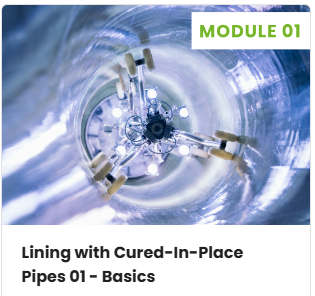
Lining methods for the renovation of sewers and pipes represent the largest group of renovation methods. In the case of the lining processes self-supporting full linings of sewers are produced on the basis of prefabricated pipes, locally manufactured pipes and locally manufactured and hardening pipes. The subject of this course is “Lining with Cured-In-Place Pipes (CIPP)” and “Lining with Spirally-Wound Pipes”.
In addition to the description of the procedure and process, the course deals in particular with the areas and limits of application, advantages and disadvantages as well as possible remediation errors and quality assurance options.
The course contains didactically prepared expert knowlege in 5 modules:
- Lining with Cured-In-Place Pipes (CIPP) - basics
- Lining with Cured-In-Place Pipes (CIPP) - Processes
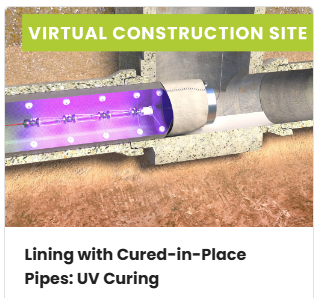
- Lining with Cured-In-Place Pipes (CIPP) - Details on the Installation of UV Cured-In-Place Pipes
- Lining with Cured-In-Place Pipes (CIPP) - final work, acceptance, renovation defects
- Lining with Spirally-Wound Pipes with Stationary Winding Machine without Reinforcement made of Metal or Plastic
LEARNING OUTCOMES
- Name and apply the most important rules and regulations
- Name lining methods, their areas of application and limitations as well as their advantages and disadvantages
- Select suitable lining methods depending on damage and boundary conditions
- Coordinate sampling and material testing
- Identify the causes of refurbishment errors and describe quality assurance options
- Recognise influences on the extension or reduction of the service life
- Select suitable methods for connecting to manholes and structures and connecting pipes.
700 € plus VAT / 2023
Lining methods for the renovation of sewers and pipes represent the largest group of renovation methods. In the case of the lining processes self-supporting full linings of sewers are produced on the basis of prefabricated pipes, locally manufactured pipes and locally manufactured and hardening pipes. The subject of this course is "Lining with Cured-In-Place Pipes (CIPP)" and " Lining with Spirally-Wound Pipes". In addition to the description of the procedure and process, the course deals in particular with the areas and limits of application, advantages and disadvantages as well as possible remediation errors and quality assurance options. The course contains didactically prepared expert knowlege in 5 modules:
- CIPP - Basics
- CIPP - Processes
- CIPP - Details on the Installation of UV Cured-In-Place Pipes
- CIPP - Final work, acceptance, renovation defects
- Lining with Spirally-Wound Pipes with Stationary Winding Machine without Reinforcement made of Metal or Plastic
LEARNING OUTCOMES
- Name and apply the most important rules and regulations
- Name lining methods, their areas of application and limitations as well as their advantages and disadvantages
- Select suitable lining methods depending on damage and boundary conditions
- Coordinate sampling and material testing
- Identify the causes of refurbishment errors and describe quality assurance options
- Recognise influences on the extension or reduction of the service life
- Select suitable methods for connecting to manholes and structures and connecting pipes
700 € plus VAT / 2023
Lining methods for the renovation of sewers and pipes represent the largest group of renovation methods. In the case of the lining processes self-supporting full linings of sewers are produced on the basis of prefabricated pipes, locally manufactured pipes and locally manufactured and hardening pipes. The subject of this course is "Lining with Cured-In-Place Pipes (CIPP)" and " Lining with Spirally-Wound Pipes".
In addition to the description of the procedure and process, the course deals in particular with the areas and limits of application, advantages and disadvantages as well as possible remediation errors and quality assurance options.
The course contains didactically prepared expert knowlege in 5 modules:
- Lining with Cured-In-Place Pipes (CIPP) - basics
- Lining with Cured-In-Place Pipes (CIPP) - Processes
- Lining with Cured-In-Place Pipes (CIPP) - Details on the Installation of UV Cured-In-Place Pipes
- Lining with Cured-In-Place Pipes (CIPP) - final work, acceptance, renovation defects
- Lining with Spirally-Wound Pipes with Stationary Winding Machine without Reinforcement made of Metal or Plastic
Replacement refers to the installation of new water, wastewater and gaspipelines in place of existing pipelines, where the new pipeline takes over the functions of the old water, wastewater and gas pipelines. The replacement process is subdivided into three methods: "open cut method", "semi open cut method" and "trenchless method". The focus of this module is the trenchless replacement method of pipelines by the means of pipe bursting, gallery techniques, and pipe extraction.
In addition to the replacement method and process description, this module discusses the areas of application and limits, the advantages and disadvantages as well as possible rehabilitation errors and options for quality assurance.
The course presents this knowledge in 6 modules:
- Pipe Bursting Basics
- Pipe Bursting
- The Welding of Plastic Pipes
- Pullback of Pipelines
- Gallery Techniques
- Pipe Extraction
LEARNING OUTCOMES
- dentify and implement the most important rules and specifications;
- identify the replacement methods' areas of application, limitations as well as advantages and disadvantages.
- identify possible causes of errors and describe quality assurance measures
- select the appropriate replacement methods based on the type of damage and limiting conditions
- identify influences affecting the extension or reduction of the useful service life of the new pipeline
- identify possible quality checks and measures for the protection of the new pipeline
- identify the effects of pipe bursting on the surrounding environment and from that calculate the required minimum distances to the adjacent utilities and structures
- identify methods of tensile force control and restriction
- dimension the pipeline insertion pit; calculate the pulling forces and the maximum bending radii of the pipeline.
- classify plastics in relation to their weldability in thermoplastics, elastomers and thermosets
- identify the influence of the density (crystallinity) of thermoplastics in terms of strength, stiffness, chemical resistance and impact strength.
- identify properties of polyethylene, and the advantages resulting therefrom
- differentiate between the various welding processes and to identify their areas of application
- identify the factors effecting the weld quality and their consequences
- identify possible errors during welding and understand their consequences on the quality
800.00 USD exclusive of VAT / 2016
Replacement refers to the installation of new water, wastewater and gaspipelines in place of existing pipelines, where the new pipeline takes over the functions of the old water, wastewater and gaspipelines. The replacement process is subdivided into three methods: “open cut method”, “semi open cut method” and “trenchless method”. The focus of this module is the trenchless replacement method of pipelines by the means of pipe bursting, gallery techniques, and pipe extraction.
In addition to the replacement method and process description this module discusses the areas of application and limits, the advantages and disadvantages as well as possible rehabilitation errors and options for quality assurance.
The course presents this knowledge in 7 modules:
- Pipe bursting basics
- Pipe bursting
- The welding of plastic pipes
- Pullback of pipelines
- Gallery techniques
- Pipe extraction
- Geotechnical and hydrogeological principles
LEARNING OUTCOMES
- identify and implement the most important rules and specifications;
- identify the replacement methods areas of application, limitations as well as advantages and disadvantages.
- identify possible causes of errors and describe quality assurance measures
- select the appropriate replacement methods based on the type of damage and limiting conditions
- identify influences effecting the extension or reduction of the useful service life of the new pipeline
- identify possible for quality checks and measures for the protection of the new pipeline
- identify the effects of pipe bursting on the surrounding environment and from that calculate the required minimum distances to the adjacent utilities and structures
- identify methods of tensile force control and restriction
- differentiate between soil types, to identify the influence of the grain shape and grain size distribution on the practical construction characteristics of the subsoil, to assess the ground state with respect to its bulk density and consistency and to derive key soil condition indicators;
- identify the different forms of water in the subsurface, to understand the movement of unbound water in the subsoil and to determine the water permeability of the soil for a structural engineering assessment ;
- dimension the pipeline insertion pit; calculate the pulling forces and the maximum bending radii of the pipeline.
- classify plastics in relation to their weldability in thermoplastics, elastomers and thermosets
- identify the influence of the density (crystallinity) of thermoplastics in terms of strength, stiffness, chemical resistance and impact strength.
- identify properties of polyethylene, and the advantages resulting therefrom
- differentiate between the various welding processes and to identify their areas of application
- identify the factors effecting the weld quality and their consequences
- identify possible errors during welding and understand their consequences on the quality
800.00 USD exclusive of VAT / 2016
This course includes tutorial services and a final examination.
Replacement refers to the installation of new sewers and drains in place of existing pipelines, where the new pipeline takes over the functions of the old sewer or drain. The replacement process is subdivided into three methods: “open cut method”, “semi open cut method” and “trenchless method”. The focus of this module is the trenchless replacement method of pipelines by the means of pipe bursting, gallery techniques, and pipe extraction.
In addition to the replacement method and process description this module discusses the areas of application and limits, the advantages and disadvantages as well as possible rehabilitation errors and options for quality assurance.
The course consists of 7 modules:
- Pipe bursting basics
- Pipe bursting
- The welding of plastic pipes
- Pullback of pipelines
- Gallery techniques
- Pipe extraction
- Geotechnical and hydrogeological principles
LEARNING OUTCOMES
- identify and implement the most important rules and specifications;
- identify the replacement methods areas of application, limitations as well as advantages and disadvantages.
- identify possible causes of errors and describe quality assurance measures
- select the appropriate replacement methods based on the type of damage and limiting conditions
- identify influences effecting the extension or reduction of the useful service life of the new pipeline
- identify possible for quality checks and measures for the protection of the new pipeline
- identify the effects of pipe bursting on the surrounding environment and from that calculate the required minimum distances to the adjacent utilities and structures
- identify methods of tensile force control and restriction
- differentiate between soil types, to identify the influence of the grain shape and grain size distribution on the practical construction characteristics of the subsoil, to assess the ground state with respect to its bulk density and consistency and to derive key soil condition indicators;
- identify the different forms of water in the subsurface, to understand the movement of unbound water in the subsoil and to determine the water permeability of the soil for a structural engineering assessment ;
- dimension the pipeline insertion pit; calculate the pulling forces and the maximum bending radii of the pipeline.
- classify plastics in relation to their weldability in thermoplastics, elastomers and thermosets
- identify the influence of the density (crystallinity) of thermoplastics in terms of strength, stiffness, chemical resistance and impact strength.
- identify properties of polyethylene, and the advantages resulting therefrom
- differentiate between the various welding processes and to identify their areas of application
- identify the factors effecting the weld quality and their consequences
- identify possible errors during welding and understand their consequences on the quality
800.00 USD exclusive of VAT / 2016
Investigation is the first of four fundamental measures within the scope of integral sewerage and drainage management. It should cover all performance aspects of the drainage system to an appropriate extent in order to establish the foundation for assessing the performance of the drainage system. The obtained results serve as evidence of compliance with due diligence and, in particular, as a basis for planning all activities related to operation, maintenance, and rehabilitation. The focus is on the structural investigation of drainage systems and addresses various options for condition assessment.
The course consists of 7 modules:
- Investigation to Determine the Structural and Operational Condition of Drain and Sewer Systems
- Geotechnical Investigations
- Geophysical Site Investigation
- Inspection from the Inside for Qualitative Condition Assessment
- Inspection from the Inside for Quantitative Condition Assessment
- Application of Coding Systems Using the Example of EN 13508-
- Coding of damages (findings), their causes, and consequences
LEARNING OUTCOMES
- Outline a structured approach for implementing an investigation process for drainage and sewerage systems.
- Identify and allocate procedures of structural investigation to their respective application areas.
- Exhibit a comprehensive understanding of the various options for structural condition assessment in order to select the best variant for each specific case.
700 € plus VAT / 2023
This course includes tutorial services and a final examination.
The installation of water pipes, in particular, drains and sewers is worldwide in large part performed using the open cut method. This at first glance “simple” construction method is actually highly complex when used in urban areas and at large depths. The numerous boundary conditions, shoring-, and installation systems require extensive technical knowledge in order to ensure a high quality workmanship.
The course consists of 5 modules on the following topics:
- Geotechnical and hydrogeological Principles
- Utility Trench Construction
- Embedment of Piping
- Installation of Pipes
- Occupational Health and Safety around Excavations
LEARNING OUTCOMES
- Identify and apply the main rules and regulations;
- Differentiate between soil types, to identify the effects of particle shape and particle size distribution on the soil properties, to assess the ground state with respect to its bulk density and soil consistency;
- Identify the different manifestations of water in the subsurface, understand the effect of free moving underground water as a form of water permeability of the soil, and determine the water permeability of soil;
- Determine the requirements for planning, tendering and construction of the utility trench along with the required shoring components and materials;
- Identify various ways of constructing unlined trenches safely and within regulation;
- Identify the various shoring/lining systems along with their limits;
- Describe the open cut method of pipe installation;
- Identify and assess construction errors;
- Implement occupational health and safety measures for the open cut method.
800.00 USD exclusive of VAT / 2022
The open-cut method is the most widely used technique for pipeline installation globally, particularly for gravity pipelines. Although it may initially appear to be a straightforward construction approach, its complexity increases significantly in urban settings and at greater depths.
This course is divided into two key sections:
- The first section covers essential technical knowledge for securing the trench and establishing a safe work zone, highlighting the various options available for trench safety.
- The second section focuses on proper pipeline installation techniques, including trench backfilling and the safe removal of shoring.
This course includes tutorial services and a final examination.
The installation of water pipes, in particular, drains and sewers is worldwide in large part performed using the open cut method. This at first glance "simple" construction method is actually highly complex when used in urban areas and at large depths. The numerous boundary conditions, shoring-, and installation systems require extensive technical knowledge in order to ensure a high quality workmanship.
The course consists of 5 modules on the following topics:
- Geotechnical and hydrogeological Principles
- Utility Trench Construction
- Embedment of Piping
- Installation of Pipes
- Occupational Health and Safety around Excavations
LEARNING OUTCOMES
After successful completion of this course, you will be able to:
• Identify and apply the main rules and regulations;
• Differentiate between soil types, to identify the effects of particle shape and particle size distribution on the soil properties, to assess the ground state with respect to its bulk density and soil consistency;
• Identify the different manifestations of water in the subsurface, understand the effect of free moving underground water as a form of water permeability of the soil, and determine the water permeability of soil;
• Determine the requirements for planning, tendering and construction of the utility trench along with the required shoring components and materials;
• Identify various ways of constructing unlined trenches safely and within regulation;
• Identify the various shoring/lining systems along with their limits;
• Describe the open cut method of pipe installation;
• Identify and assess construction errors;
• Implement occupational health and safety measures for the open cut method.
700.00 EUR plus VAT / 2022
The open-cut method is the most commonly used technique for pipeline installation worldwide, particularly for gravity pipelines. While this approach may initially appear to be a straightforward construction method, it becomes significantly more complex when applied in urban environments or at substantial depths.
This course is structured into two comprehensive parts:
- The first part provides essential technical knowledge on securing the trench to create a safe working environment. It explores the wide range of options available for trench safety and stabilization.
- The second part focuses on proper pipeline installation techniques, including backfilling the trench and safely removing the shoring.
This course includes tutorial services and a final examination.
Cleaning is one of the most important maintenance measures when it comes to ensuring a continuous performance of drainage systems. This module covers essential knowledge regarding the cause and effect of deposits, and provides a strategic approach to the development of a cleaning plan that enables for the optimisation of operating costs and in particular asset preservation.
The course consists of 4 Modules on the following topics:
- Solids in sewers
- Cleaning strategy and program
- High pressure cleaning / Cleaning vehicles
- Cleaning nozzles
LEARNING OUTCOMES
- Describe the causes and effects of sediments.
- Create a cost effective cleaning schedule with special consideration of the channels structural condition.
- Identify cost saving opportunities.
- Identify quality control concepts.
- Develop quality management requirements.
700.00 EUR plus VAT / 2013
This course includes tutorial services and a final examination.
Cleaning is one of the most important maintenance measures when it comes to ensuring a continuous performance of drainage systems. This module expands on the topics covered in module “D-05 cleaning I”, by providing further knowledge on the applications and limits of flushing methods, mechanical cleaning methods and special methods, such as physical and chemical sewer cleaning. Discussed are both the accessible and non-accessible lines, as well as pressure lines. It concludes with providing constructive solutions for the minimization of solids entry into the sewer system, with the aim of preventing the formation of deposits and hence the reduction of cleaning efforts and frequencies.
The course consists of 5 modules covering the following topics:
- Flushing methods
- Mechanical and Miscellaneous methods
- Cleaning of large profiles
- Cleaning of pressure lines
- Constructive design measures for the reduction of deposit
LEARNING OUTCOMES
- describe the flushing process,
- differentiate between bed load and suspension waves,
- identify the effects of bed load and suspension waves,
- differentiate between flushing devices according to their structural design and technical specifications,
- identify the operating limits of automatically operating flushing gates (without external power),
- identify the steps for creating an operational flushing concept,
- describe the back-up flushing process and identify its application limits,
- identify mechanical cleaning methods and their applications,
- determine the various mechanical cleaning boundary conditions based on the pipe diameter, type and amount of deposits ,
- to select the appropriate rotary cutters chain formation based on the type of deposit or obstacle
- to identify application areas for the use of physical, chemical and biological processes,
- identify methods for the cleaning of large profile pipes,
- identify and describe the methods and processes used for the cleaning of pressure lines,
- describe the design measures and principles for the prevention of deposits.
500.00 EUR plus VAT / 2013
The installation of supply and disposal lines is predominantly carried out using the open-cut method, which involves trench excavation, pipe laying with shoring for support, and subsequent backfilling. However, the numerous disadvantages of this method, coupled with increasing environmental awareness, highlight the growing need for trenchless technologies in pipeline and utility network construction.
The “Utility Tunnelling” module is divided into seven lessons, each covering a specific topic. To enhance your understanding, each lesson includes links to supplementary literature. While this additional material is optional and not included in the exam, it serves as a resource for deeper exploration.
The module culminates in a final examination that encompasses all the content covered throughout the course.
To complete the course successfully and efficiently within four weeks, we suggest the following schedule, which distributes the lessons evenly across the period:
- Week 1: Introduction, Fundamentals and Geotechnical Investigations, Pipe Jacking (Part 1)
- Week 2: Pipe Jacking (Part 2), Microtunnelling
- Week 3: Jacking Pipes, Jacking Steering
- Week 4: Starting and Target Shafts, Final Exam
LEARNING OUTCOMES
Upon completing the e-learning module "Utility Tunnelling," you will have a solid understanding of the fundamentals of various trenchless construction methods, including pipe jacking and microtunnelling. You will learn how to apply these methods within the context of their technical components and process variations. Additionally, you will explore the range of pipe materials available for use, as well as the standard specifications for pipes and pipe joints—critical knowledge for effective implementation.
You will also gain insight into the geological, hydrogeological, and geotechnical principles essential for applying trenchless construction methods and conducting ground assessments tailored to specific project needs. Finally, the module will introduce you to the planning and construction of access shafts, emphasizing how to adapt these methods to suit varying site conditions.
700 € plus VAT / 2012
Lining methods for the renovation of sewers and pipes represent the largest group of renovation methods. In the case of the lining processes self-supporting full linings of sewers are produced on the basis of prefabricated pipes, locally manufactured pipes and locally manufactured and hardening pipes. The subject of this course is "Lining with Cured-In-Place Pipes (CIPP)" and " Lining with Spirally-Wound Pipes".
In addition to the description of the procedure and process, the course deals in particular with the areas and limits of application, advantages and disadvantages as well as possible remediation errors and quality assurance options.
The course contains didactically prepared expert knowlege in 5 modules:
- Lining with Cured-In-Place Pipes (CIPP) - basics
- Lining with Cured-In-Place Pipes (CIPP) - Processes
- Lining with Cured-In-Place Pipes (CIPP) - Details on the Installation of UV Cured-In-Place Pipes
- Lining with Cured-In-Place Pipes (CIPP) - final work, acceptance, renovation defects
- Lining with Spirally-Wound Pipes with Stationary Winding Machine without Reinforcement made of Metal or Plastic
LEARNING OUTCOMES
After successfully completing this course, you will be able to
- Name and apply the most important rules and regulations
- Name lining methods, their areas of application and limitations as well as their advantages and disadvantages
- Select suitable lining methods depending on damage and boundary conditions
- Coordinate sampling and material testing
- Identify the causes of refurbishment errors and describe quality assurance options
- Recognise influences on the extension or reduction of the service life
- Select suitable methods for connecting to manholes and structures and connecting pipes.
700 € plus VAT / 2023
The overall challenge of each generation that takes over responsibility for a drain and sewer system is to construct new wastewater collection systems or to expand already existing ones, and to inspect, repair, renovate and replace, or rather adapt, them to the strengthened groundwater and water protection standards. The primary objective of all measures has to be the creation of a fully operational and long lasting drain and sewer system. This is created to transport the wastewater safely and efficiently between the producers of wastewater and the wastewater treatment plant. Furthermore, rehabilitation and maintenance work should be easy to carry out. Thus, sound expertise is required in planning, construction, operation and maintenance. This module teaches the most elementary basics needed for a comprehensive design of an integral drain and sewage framework.
LEARNING OUTCOMES
After successfully completing this course, you will have a sound knowledge of:
- Water cycle (transport and storage of water) at a global and regional level
- Interactions in the urban water cycle as well as effects on groundwater and waters
- Facts and figures regarding the global water demand and water exploitation
- Significance of wastewater collection systems in the overall context of water management
- Cycle of resources (water collection, water distribution, wastewater discharge, wastewater treatment)
- Terms and definitions
- Requirements for wastewater collection systems regarding their functionality and performance capacity
- Types of wastewater collection systems
- Structure and limiting conditions of sewer systems
The aspects of occupational health and safety that must be taken into account in the context of civil engineering work, especially in the construction of pipelines and sewers using the open cut method, are very diverse. They harbor a considerable potential for danger for those working on the construction site, but also for uninvolved persons.
After completing this module, you will have knowledge regarding:
- Risks and hazardous areas;
- Securing construction sites in traffic areas;
- Tools and equipment for safe working.
The aspects of occupational health and safety that must be taken into account in the context of civil engineering work, especially in the construction of pipelines and sewers using the open cut method, are very diverse. They harbor a considerable potential for danger for those working on the construction site, but also for uninvolved persons.
LEARNING OUTCOMES
- Risks and hazardous areas;
- Securing construction sites in traffic areas;
- Tools and equipment for safe working.
Publisher: Prof. Dr.-Ing. Stein & Partner GmbH / 2016
This module provides the essential basic knowledge regarding materials, sealing systems, and functions of manholes as well as requirements and methods of connections to manholes. With regards to road catch basins, their function and types of construction are explained, as well as the possibility of using these systems for decentralized solids retention. The content concludes with stormwater basins and how they are differentiated in terms of function, type, drainage system and layout.
LEARNING OUTCOMES
- Functions of and requirements for manholes, as well as materials and sealants used;
- Types of construction and main components of road catch basins, as well as the type of connection to the sewer or manhole;
- Requirements for connections, as well as variants of connection to manholes;
- Differentiation of stormwater basins in terms of their function, by type and drainage system, and by arrangement and tasks.
This module provides essential basic knowledge about the historical development of sewage pipes including sealing systems, which is particularly relevant for the rehabilitation of old pipes and sewers; the current status of pipe materials and sealing systems, cross-sectional shapes and dimensions, functional and dimensional requirements for pipes and fittings.
After completing this module, you will have a sound knowledge of:
- Minimum nominal sizes for new construction of drain and sewers systems;
- Relevant materials and material combinations;
- Functional and dimensional requirements for pipes and pipe materials;
- Factors influencing material selection;
- Requirements for pipe joints; and
- Functional principles of gaskets.
In this module, the fundamentals of the materials applied in the lining processes with continuous pipes are presented and discussed.
Publisher: Prof. Dr.-Ing. Stein & Partner GmbH / 2006
This presentation is part of the series of presentations "Utility Tunnelling" and deals with the different materials of jacking pipes and the corresponding pipe joints.
Publisher: Prof. Dr.-Ing. Stein & Partner GmbH (2008)
This presentation is part of the series of presentations "Utility Tunnelling" and deals with the building of starting and target shafts and the design of exit and entry openings.
Publisher: Prof. Dr.-Ing. Stein & Partner GmbH (2008)
Publisher: Prof. Dr.-Ing. Stein & Partner GmbH (2016)
The construction of sewers is often carried out using the open construction method. Depending on the design, this results in pipe-soil systems with different external loads on the sewer. To understand these relationships, the soil mechanical and hydrogeological principles for characterizing the subsoil are explained.
After completing this module, you will have a sound knowledge of how:
- To differentiate between soil types;
- To identify the influences of grain shape and grain size distribution on the practical construction properties of the subsoil and
- To name the different appearances of water in the subsoil;
- To determine the water permeability of the soil for a constructional assessment of the soil.
The documentation of damages, defects, other peculiarities (findings) in sewers and pipes within the scope of CCTV inspection is not possible without a uniform nomenclature. In Europe, EN 13508 Part 2: "Coding system for visual inspection" provides the normative basis for documenting and describing various findings, which later serve the engineer as a basis for assessment.
This module provides the basic knowledge required for the structure and application of the coding system.
LEARNING OUTCOMES
- coding system according to EN 13508-2;
- differentiation between basic information and findings;
- differences in the coding system between sewers and manholes;
- codes for route finding, tightness indication, location on the circumference and
- procedure of inspection in an object.
Publisher: Prof. Dr.-Ing. Stein & Partner GmbH, Editorial: STEIN Ingenieure GmbH / 2023
The construction of sewers is often carried out using the open construction method. Depending on the design, this results in pipe-soil systems with different external loads on the sewer. To understand these relationships, the soil mechanical and hydrogeological principles for characterizing the subsoil are explained.
LEARNING OUTCOMES
- To differentiate between soil types;
- To identify the influences of grain shape and grain size distribution on the practical construction properties of the subsoil and
- To name the different appearances of water in the subsoil;
- To determine the water permeability of the soil for a constructional assessment of the soil.
Publisher: Prof. Dr.-Ing. Stein & Partner GmbH / 2016
The construction of sewers is often carried out using the open construction method. Depending on the design, this results in pipe-soil systems with different external loads on the sewer. To understand these relationships, the soil mechanical and hydrogeological principles for characterizing the subsoil are explained.
LEARNING OUTCOMES
- To differentiate between soil types;
- To identify the influences of grain shape and grain size distribution on the practical construction properties of the subsoil and
- To name the different appearances of water in the subsoil;
- To determine the water permeability of the soil for a constructional assessment of the soil.
Publisher: Prof. Dr.-Ing. Stein & Partner GmbH / 2016
This lesson builds on the module "Application of coding systems using the example of EN 13508-2" and introduces the coding of damage (findings) for sewers and drains. In more detail, the causes and consequences of damage are explained for the damage and, in some cases, the damage mechanisms are presented as well.
LEARNING OUTCOMES
- apply the coding system according to EN 13508-2
- classify damage
- name causes and consequences of damage
Publisher: Prof. Dr.-Ing. Stein & Partner GmbH, Editorial: STEIN Ingenieure GmbH / 2023
The aim of this lecture is to provide an overview of the main damage groups, their causes, and their consequences.
Publisher: Prof. Dr.-Ing. Stein & Partner GmbH (2006)
This module teaches the basics of geotechnical investigations for civil engineering purposes. The described subsoil investigation by indirect (e.g., drilling methods) and direct exploration methods (e.g., dynamic sounding) form the basis for an understanding of a civil engineering description and evaluation of soil and rock.
LEARNING OUTCOMES
- The objective of a geotechnical investigation;
- The purpose of structural and subsoil investigation by means of excavations;
- Differentiation between direct and indirect excavation methods, such as drilling methods and indirect excavation methods, such as dynamic sounding.
Publisher: Prof. Dr.-Ing. Stein & Partner GmbH, edited by: STEIN Ingenieure GmbH / 2023
Large profiles and wastewater structures were manufactured on site in the past. Various methods and construction materials were used for this purpose. Professional maintenance of these structures requires a detailed understanding of the construction materials used and the manufacturing processes applied. This module provides the necessary basic knowledge for this understanding. Learning objectives:
After completing this module, you will have a sound knowledge of:
• Construction methods for large masonry profiles; • Typical damage to large profiles; • Special aspects of condition assessment for structures and large profiles; • Design and implementation of an extended investigation programme for condition assessment, classification and evaluation; • Design of an extended structural stability assessment.
This module teaches the basics of geophysical soil investigation and is to be understood as a supplement to the module "Geotechnical Investigation". Geophysical measurement methods belong to the indirect exploration methods and allow statements regarding local inhomogeneities in the pipeline zone (e.g. bedding defects, cavities, disruptions, concrete encasements) or, in the case of investigations of existing sewers and pipelines, statements regarding the condition and load-bearing capacity of the embedment. In addition to ground or georadar (EMR - electromagnetic reflection), which is well-known in pipeline construction and rehabilitation, the measurement methods seismic, seismic tomography, air gun seismic, magnetics, electromagnetics and geoelectrics are also introduced.
LEARNING OUTCOMES
- Procedural principles and
- Assignment of application areas to procedures of geophysical ground investigation.
Publisher: Prof. Dr.-Ing. Stein & Partner GmbH, Editorial: STEIN Ingenieure GmbH / 2023
This module teaches the basics of geotechnical investigations for civil engineering purposes. The described subsoil investigation by indirect (e.g., drilling methods) and direct exploration methods (e.g., dynamic sounding) form the basis for an understanding of a civil engineering description and evaluation of soil and rock.
LEARNING OUTCOMES
- The objective of a geotechnical investigation;
- The purpose of structural and subsoil investigation by means of excavations;
- Differentiation between direct and indirect excavation methods, such as drilling methods and indirect excavation methods, such as dynamic sounding.
Published by: Prof. Dr.-Ing. Stein & Partner GmbH, edited by: STEIN Ingenieure GmbH / 2023
This module provides a comprehensive overview of direct and indirect optical inspection methods like CCTV for qualitative condition assessment of pipelines and sewers as well as manholes. In terms of content, the module thus belongs to the topic block "INVESTIGATION", the first of the four basic activities within the framework of integral urban drainage management according to EN 752. The optical inspection procedures presented here provide an essential basis for assessing the performance of the drain and sewer system or for developing the rehabilitation plan.
LEARNING OUTCOMES
- Inspection object requirements;
- Compilation of necessary equipment for direct optical inspection;
- Investigations in extended recording of defect extent;
- Procedures and methods of indirect inspection and
- Its fields of application and limitations;
- As well as requirements for data management, data acquisition, data export and recording with sewer acquisition software.
Published by: Prof. Dr.-Ing. Stein & Partner GmbH, edited by: STEIN Ingenieure GmbH / 2023
This module gives an overview of methods of inspection from the inside for quantitative condition assessment. It is to be understood as a supplement to the module "Optical inspection from the inside for qualitative condition recording" and thus belongs in terms of content to the topic block "INVESTIGATION", the first of the four basic activities within the framework of the integral urban drainage management according to EN 752. The procedures presented here provide an essential basis for the assessment of the performance of the drain and sewer system or for developing the rehabilitation plan.
LEARNING OUTCOMES
- Areas of application and
- Methods of quantitative condition assessment.
Published by: Prof. Dr.-Ing. Stein & Partner GmbH, edited by: STEIN Ingenieure GmbH / 2023
This module provides an introduction to the first of the four basic activities within the framework of integral urban drainage management according to EN 752, the INVESTIGATION. It is intended to cover all performance aspects of the drain and sewer system to the appropriate extent in order to provide the basis for the subsequent assessment of their performance. Therefore, this module provides an overview of the required investigation steps, collection and review of relevant information, and procedures for investigating the structural and operational condition of drain and sewer systems.
LEARNING OUTCOMES
- The purpose of an investigation;
- The necessary investigation steps and required relevant information; and
- Procedures for investigating the structural and operational condition of drainage systems
Published by: Prof. Dr.-Ing. Stein & Partner GmbH, edited by: STEIN Ingenieure GmbH / 2023
This presentation is part of the series of presentations "Utility Tunnelling" and deals with the fundamentals in geology, hydrogeology and geotechnical engineering.
Publisher: Prof. Dr.-Ing. Stein & Partner GmbH (2008)
Drain and sewer systems are used for the collection and discharge of wastewater. The module provides basic knowledge about the objectives, functional requirements, design and operation, modes of operation, and drainage methods of drain and sewer systems.
This module focuses exclusively on drain and sewer systems that are operated as gravity systems.
LEARNING OUTCOMES
- Boundaries, objectives, and functional requirements;
- Structure and operation modes;
- Types of operation and drainage methods of drainage systems.
This module provides an overview of the historical development of water supply and sanitation and their meaning cultural development of mankind.
After completing this module, you will have knowledge regarding:
- Principal eras and
- Their contribution to the sanitary development.
This module provides an essential basic understanding of the global hydrologic cycle along with the quantitative description of the natural and urban hydrological cycle through the hydrologic balance equation.
LEARNING OUTCOMES
- Identifying the main components of the hydrologic cycle;
- The water storage involved and their possible combinations in interaction and water transport processes;
- The hydrological balance equation its components;
- Factors influencing the urban water cycle.
Publisher: Prof. Dr.-Ing. Stein & Partner GmbH
Publisher: Prof. Dr.-Ing. Stein & Partner GmbH (2005)
The presentation shows the new calculation program "Co-Jack" (Computing and Controlling Pipe Jacking) for a structural simulation of pipe jackings.